You can't be the engineer, designer, marketer and lawyer all at once — so how does one founder cover nine jobs?
A one-person company still has nine functions. Here is where each is fine at 80%, where the last 20% costs real money, and the three ways solo founders actually close the gap.
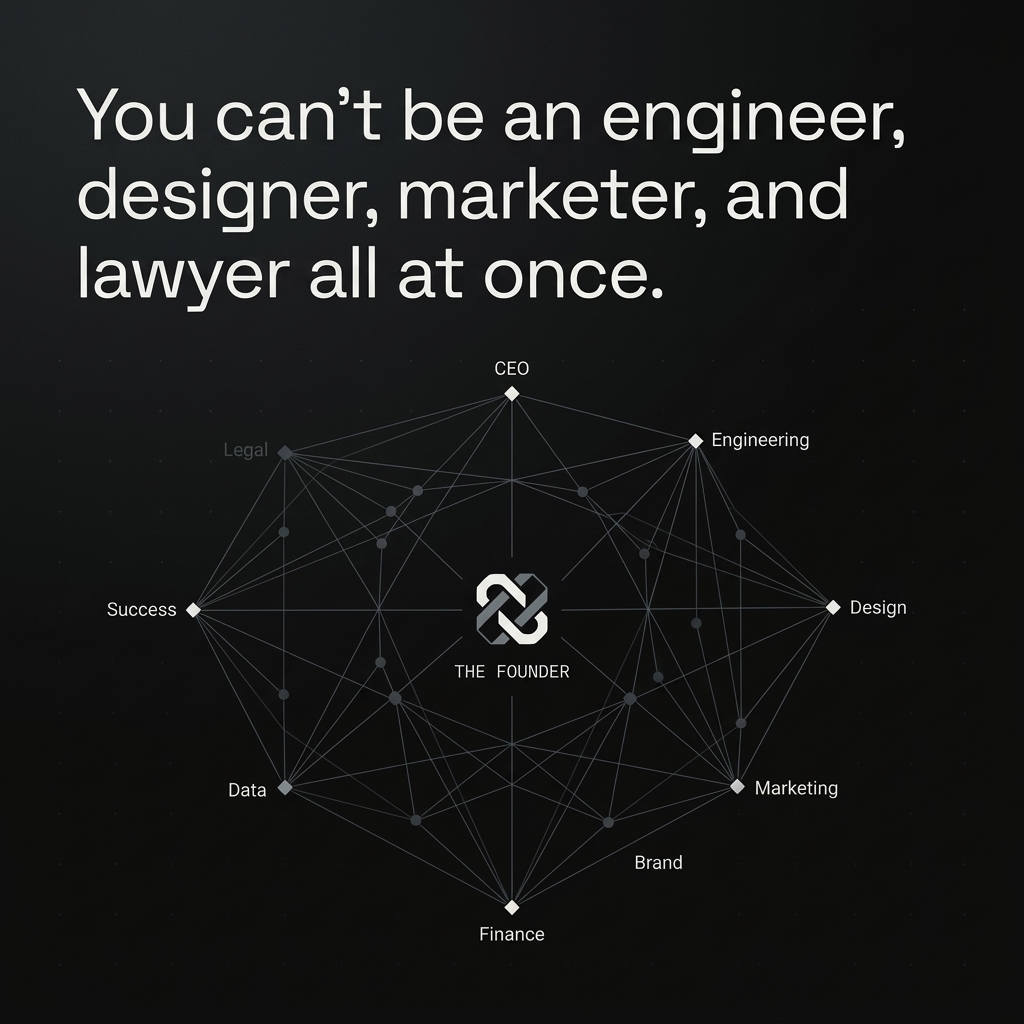
The Tuesday that has no job title
At nine you are debugging a webhook. At eleven you are writing landing-page copy. At two you are reading a contractor agreement, looking for the clause that gives away your IP. At four it is the cash-flow sheet, and at six a churned customer's email that deserves a better answer than the one you have energy for. Five jobs, one person, each done in the residue of the last.
The tax on this is not the hours. It is the switching. Gloria Mark's research at UC Irvine on interrupted work put the time to fully return to a task after a switch at roughly 23 minutes. Five real switches in a day and you have spent close to two hours re-entering things you were already inside. That is the honest shape of the "wear every hat" week: not heroic, just leaky.
The problem is not the skills
You can learn any of the nine functions to a usable 80% in a few focused weekends. The internet is built for exactly that. So the common advice — "just learn it" — is not wrong, it is aimed at the wrong part of the problem.
The expensive part is the last 20% of each discipline: the piece where domain judgment lives, where the mistakes are asymmetric — cheap to avoid, expensive to discover — and where a beginner cannot see the hole before stepping in it. The cash-flow sheet is fine at 80%. The registration deadline the sheet knows nothing about is not. The contract is fine at 80%. The one clause is not.
Where the last 20% lives, function by function
| Function | Fine alone at 80% | The 20% that costs real money |
|---|---|---|
| Engineering | Shipping the feature | Backups you have never restored, the migration that loses rows, the auth gate that is routing, not security |
| Design | A clean, readable page | The conversion detail — the same traffic at 0.6% versus 2% is a threefold difference in customers, decided by one section's order |
| Marketing | Writing the posts | Choosing the channel. A quarter on the wrong one is a quarter gone, with good content to show for it |
| Brand | A logo and a colour | One voice across every surface, and a name you can actually register |
| Finance | The spreadsheet | The deadlines the spreadsheet does not know — corporate-tax registration in the UAE has carried an AED 10,000 penalty for missing it — and runway maths under real churn rather than hoped-for churn |
| Data | A dashboard | Measuring the wrong thing with confidence, for months |
| Customer success | Replying fast | Telling churn you can fix from churn that means you sold to the wrong customer |
| Legal | Filling a template | The IP-assignment clause in the contractor agreement; terms that do not match what the product actually does |
| CEO | Deciding | Sequencing — deciding what the company will not do this month, and making the other eight wait their turn |
Read the right-hand column again as a bill. None of those items is a skill you lack. Each is a question you did not know to ask, at the moment it would have been cheap to ask it.
The three ways founders actually close the gap
Buy the 20%. Fractional and contract help is the honest answer for the irreversible moments: incorporation papers, the first hire's contract, the pricing change you cannot easily reverse. Rough rates in this market run about USD 250–500 an hour for a lawyer, 2,000–5,000 a month for a fractional CFO, 60–150 an hour for a designer worth having. Right at the moments that deserve it. Wrong as a default — a pre-revenue company cannot carry nine retainers, and the whole point of building alone was not spending like a team of nine.
Learn the 20% yourself. Right for exactly one function: your core discipline, the thing the company is actually made of. Learn that one deep. For the other eight, "I'll learn it properly" is usually FOMO wearing the costume of diligence — a month of evening courses in a field you will use twice a year, ending where a two-hour consult would have started.
Structure the nine as a team you consult, not hats you wear. This is what the picture at the top of the post is trying to show, and the geometry matters more than the labels. The founder sits in the middle — not replaced, not sidelined; every line runs through them. Around the founder sit nine roles. And critically, there are lines between the roles, not just spokes to the centre, because the useful part of a team is that finance objects to marketing's plan before the founder ever hears it, and legal has read the clause before the founder is asked to sign.
That is the design bet behind how Conseal works: a CEO-shaped role that sequences, eight specialist roles with standing briefs and permission to disagree, and one human who decides. The founder's calendar does not lose the nine functions. It loses doing them badly and gains choosing between nine informed positions.
The limit, stated plainly so the picture is not oversold: nothing on that diagram can sign anything, carry liability, meet your first ten customers, or want the company to exist. The roles argue and produce; the person in the middle owns every consequence. That is why the founder is drawn at the centre rather than as one node among nine.
What changes on the Tuesday
The tasks are the same. The first move on each one changes.
Before the landing copy is written, marketing says which channel it is for and design says what the one action on the page is — so the copy is written once instead of three times. Before the contractor agreement is signed, legal has already flagged the IP clause, and the question to the human lawyer is one sentence instead of one hour. The cash-flow sheet arrives with the registration calendar attached, because finance holds the deadline and the founder holds the decision. The churned customer's email gets a reply informed by the pattern across the last twenty, not the tiredness of the last ten minutes.
And the switching cost drops, not because the functions went away, but because the founder is no longer the only place any of them lives. Re-entering "finance mode" is cheaper when finance kept its own notes.
The skill that actually matters
The real solo-founder skill was never being nine people. It is knowing which of the nine to consult before an irreversible decision — and having somewhere to consult them at eleven on a Tuesday night, when the decision is in front of you and the eight people you would have asked at a bigger company do not exist.
Look at the picture once more. One founder in the middle. Nine roles around them, talking to each other. And no line from any role that goes anywhere except through the person who decides.